Tuesday, 19 May 2026

Lusail Circuit Launches Citywide Art Installation for Qatar Grand Prix

Published: Wednesday, November 26, 2025
Lusail Circuit Launches Citywide Art Installation for Qatar Grand Prix
Top Stories

Doha has taken on a new artistic identity ahead of this year’s FORMULA 1® QATAR AIRWAYS QATAR GRAND PRIX, with ten towering Formula 1® helmet sculptures installed across the city as part of a large-scale public art initiative led by Lusail International Circuit (LIC).

Standing at 1.8 meters tall, the installations—on display through 30 November 2025—feature works by eight prominent Qatari artists, each weaving themes of heritage, identity, and innovation into the universally recognized symbol of motorsport.
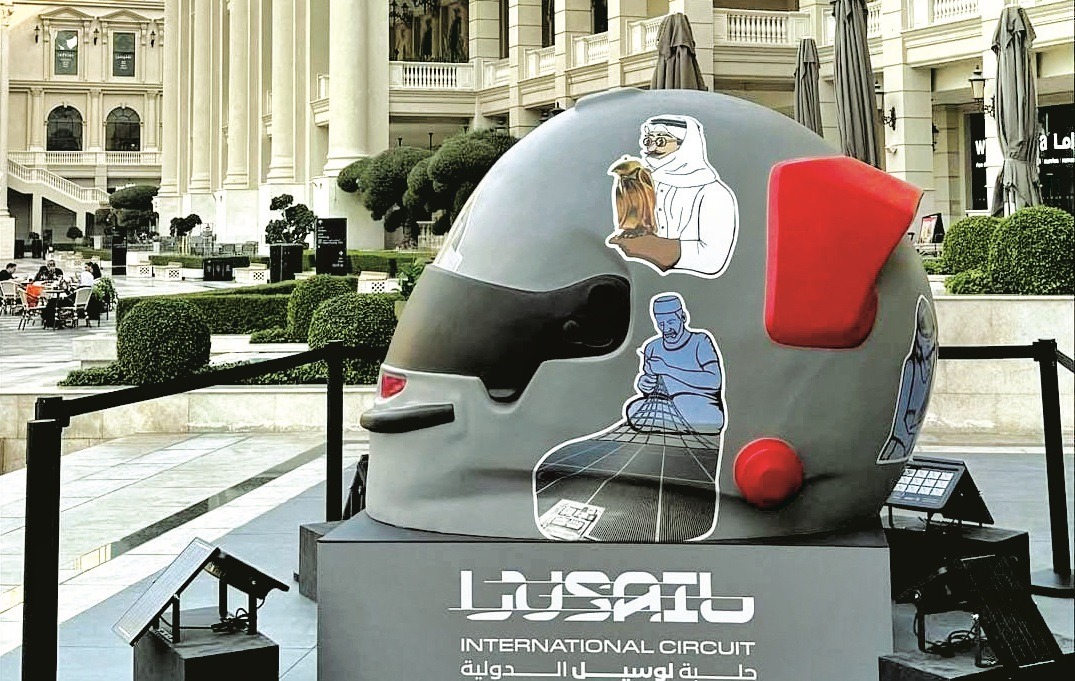
Two official LIC-branded helmets greet travelers and media personnel at Hamad International Airport and the St. Regis Doha, while the other pieces appear at key cultural and commercial landmarks:

Old Doha Port – The Rise of Glory by Fatima Mohammed Shaker
Shaker blends Qatar’s map with symbols of national pride, capturing a sense of authenticity and forward momentum.

Doha Festival City – Connections by Hala Al-Darbasti
A vibrant acrylic work exploring the small yet powerful details that link individuals to one another. Al-Darbasti described the experience as “deeply meaningful,” noting her pride in contributing to Qatar’s motorsport scene.

Lusail International Circuit – The Camel by Laila Al-Qaedi
Traditional camel markings are reimagined as dynamic, racing-inspired motifs, drawing parallels between desert endurance and Formula 1® performance.

Msheireb Downtown – Heritage in Acceleration by Noor Abuissa
Islamic geometric patterns and Doha’s skyline appear in fluid motion, capturing the synergy between spiritual symmetry and racing speed.

Place Vendôme – Fusion of Speed and Heritage by Jaber Henzab
A bold composition that merges Qatari craftsmanship with the precision of F1®. Henzab called the project a “meaningful milestone” in his career.

Qatar Foundation – Velocity of Heritage by Kaltham Al-Fakhroo
Architectural motifs from Qatar’s historic buildings intertwine with the circuit’s high-energy character. Al-Fakhroo said the collaboration reaffirmed LIC’s “unique aura.”

Souq Waqif – The Land of Abundance and Oysters by Zainab AlShibani
A poetic tribute to pearl divers, connecting maritime tradition to the discipline and bravery found in racing.

VVIP Lounge, LIC – The Falcon: A Renewed Legacy by Noura Abdulrahman Al Ibrahim
A Saker falcon—symbol of strength—takes on a futuristic feel, revealing the technological complexity hidden inside an F1® machine.
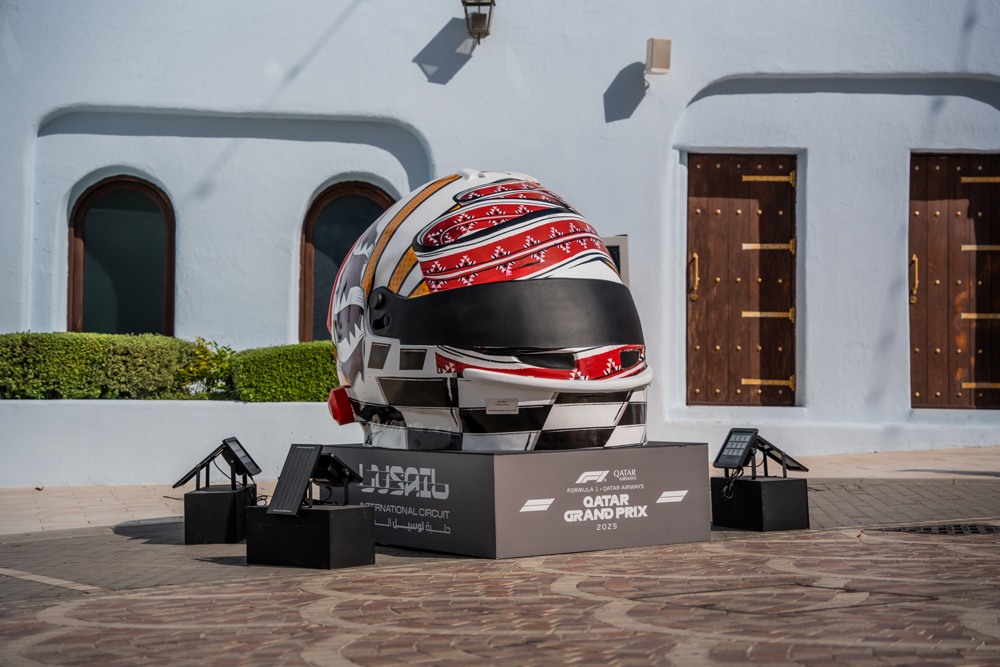
Fatima Al Qaedi, LIC’s Marketing Manager, described the exhibition as a tribute to “Qatari imagination and artistic excellence.” She highlighted how each helmet transforms the essence of the nation—from pearl diving to falconry—into contemporary visual narratives. “We encourage residents and visitors to follow the helmet trail and see Formula 1® through a uniquely Qatari perspective,” she said.
Race Weekend Line-Up
Fans still have a chance to secure one of the remaining tickets for the 2025 Qatar Grand Prix, running 28–30 November:

Friday, 28 November: Opening ceremony, F1® practice, Sprint Qualifying, support races, and a performance by Seal.

Saturday, 29 November: High-energy F1® Sprint Race, FIA Formula 2™ and Porsche Carrera Cup Middle East action, capped by a concert from Cheb Khaled.

Sunday, 30 November: The main 57-lap Grand Prix, preceded by the Drivers’ Parade and final support races, closing with a headline show by Metallica.

Tickets are available at tickets.lcsc.qa

Saudi Aviation Growth Puts Spotlight on Pilot Training Capacity Challenges

Published: Monday, April 13, 2026
Saudi Aviation Growth Puts Spotlight on Pilot Training Capacity Challenges
Top Stories

Saudi Arabia’s aviation industry is moving into a new growth cycle as airlines expand their fleets and strengthen regional and international connectivity, supported largely by new narrowbody aircraft orders.

This rapid expansion is expected to significantly increase the need for trained pilots across the region. Industry projections from the Boeing Pilot and Technician Outlook estimate that the Middle East will require more than 58,000 new pilots over the next 20 years as carriers scale up operations and route networks.

Saudi Arabia is expected to account for a large portion of that demand, reflecting its ongoing investment in aviation development and airline capacity growth.

The pressure is not limited to the region. Global forecasts show similar trends across key markets. CAE’s Aviation Talent Forecast suggests North America could need over 130,000 pilots by 2032, while the Asia-Pacific region may face a shortfall of more than 250,000 pilots.

Aviation experts say this simultaneous expansion is placing significant strain on global training systems and simulator capacity.

Martynas Mazeika, Chief Growth Officer at BAA Training, part of Avia Solutions Group, said the pace of airline expansion is reshaping training requirements. He noted that as new aircraft enter service each year, demand for qualified pilots is rising in parallel, requiring airlines to rely on scalable training partnerships and international resources.

He added that access to simulator capacity and flexible training programs is becoming increasingly important for airlines managing long-term fleet growth.

Based on Boeing’s estimates and standard requirements of around 200 flight hours per pilot, training more than 58,000 pilots in the Middle East would require roughly 11.6 million flight training hours.

By comparison, a typical flight academy operating around ten training aircraft generates only about 12,000 to 15,000 hours annually, underscoring the scale of capacity expansion needed to meet demand.

Simulator training presents a similar challenge. Preparing pilots would require approximately 1.1 million hours on full flight simulators. With each simulator typically delivering 5,000 to 6,000 training hours per year, industry capacity will need to expand significantly.

Mazeika said fleet expansion is not limited to the Middle East, pointing out that airlines in North America, India, and Southeast Asia are also increasing aircraft orders. He stressed that access to global training infrastructure is becoming a key factor in supporting airline growth strategies.

As Saudi carriers continue to grow their narrowbody fleets, demand is expected to rise for type rating and recurrent training, which prepare pilots for new aircraft and maintain operational standards as networks expand.

BAA Training currently provides type rating, recurrent training, and simulator-based programs through its global network of training centres and partners.

With aviation expansion accelerating across Saudi Arabia and the wider Middle East, industry stakeholders say that scalable training systems and international cooperation will be essential to keep pilot supply aligned with fleet growth.

Source: ZAWYA

Hajj Ministry: Only Hajj Visa Valid for Pilgrimage, Authorities Clarify Official Rules

Published: Monday, April 13, 2026
Hajj Ministry: Only Hajj Visa Valid for Pilgrimage, Authorities Clarify Official Rules
Top Stories

The Ministry of Hajj and Umrah has reiterated that international pilgrims must obtain a Hajj visa specifically issued for the pilgrimage. Officials stressed that entry for Hajj will not be allowed under any other visa category, including visit, transit, Umrah, or tourist visas.

For citizens and residents inside the Kingdom, Hajj arrangements are processed through the Nusuk, following completion of the official reservation procedures.

The ministry further stated that all bookings must be made strictly through approved and authorized platforms. It cautioned pilgrims against engaging with unofficial agents or unverified channels when arranging Hajj participation.

Source: Saudi Gazette

Saudi Tourism Introduces Hajj Penalties of Up to SR50,000 for Hospitality Violations

Published: Sunday, April 12, 2026
Saudi Tourism Introduces Hajj Penalties of Up to SR50,000 for Hospitality Violations
Top Stories

The Ministry of Tourism (Saudi Arabia) has announced a new regulatory framework detailing violations and penalties for hospitality providers operating in the holy cities of Makkah and Madinah during the Hajj season. The measures are designed to strengthen service quality for pilgrims and ensure consistent compliance across the sector.

According to the ministry, the Hajj season officially extends each year from the first day of Dhul Qadah until mid-Muharram. Under the updated rules, penalties will escalate for repeated violations, whether they occur before, during, or after the pilgrimage period.

If an offense committed during Hajj is a repeat of a previous violation, authorities will impose either the minimum fine (if it is higher than the earlier penalty) or double the previous amount if it is lower. Within the same season, any repeated breach will automatically result in doubled fines. Violations repeated after the season, but linked to Hajj-related offenses, will also face progressively higher penalties depending on frequency.

The regulations further state that repeated non-financial violations may lead to temporary suspension or closure of facilities during the Hajj period. A third recurrence could result in full license revocation. Authorities have emphasized a phased enforcement approach, allowing fines to be increased for repeat offenses while remaining within the maximum legal limit.

Hospitality establishments have been divided into five classifications, ranging from luxury five-star hotels to unclassified and temporary accommodations used specifically for pilgrims. Penalties are also adjusted according to business size, with micro enterprises fined at 25% of the base rate, small businesses at 50%, medium enterprises at 75%, and large establishments at 100%.

Financial penalties in Makkah and Madinah range between SAR 2,000 and SAR 14,000, alongside additional measures such as temporary closure or permanent license cancellation for repeated violations. For temporary Hajj accommodation providers, fines are significantly broader, ranging from SAR 1,000 to SAR 50,000, with enforcement actions including suspension until compliance is achieved or full revocation of operating licenses.

Source: Saudi Gazette

Saudi Railways Unveils Five Logistics Routes Linking Gulf Ports with Saudi Arabia

Published: Sunday, April 12, 2026
Saudi Railways Unveils Five Logistics Routes Linking Gulf Ports with Saudi Arabia
Top Stories

Saudi Railways (SAR) has expanded its freight operations with the introduction of five new logistics routes, further developing an integrated national transport network designed to enhance cargo efficiency across the Kingdom and beyond.

The new corridors link Arabian Gulf ports with Saudi Arabia’s central and northern regions, while also extending connectivity toward Red Sea ports and neighbouring countries to the north. By combining rail and road transport, the system is intended to improve supply chain performance and ensure smoother movement of goods across key domestic and international trade routes.

Operations are coordinated through a unified logistics framework that includes the Riyadh Dry Port, along with SAR freight facilities in Dammam, Jubail, Ras Al Khair, Al Kharj, Hail, and Qurayyat. These hubs are connected to major ports on both the Arabian Gulf and Red Sea coasts, strengthening links between industrial zones, economic centres, and global shipping networks.

The routes are designed to handle a wide variety of cargo, supporting national supply chains and key industries such as petrochemicals and mining. They are also expected to facilitate more efficient import and export flows, while improving transit options for regional markets.

According to Dr. Bashar Al-Malik, Chief Executive Officer of Saudi Railways (SAR), the initiative offers a comprehensive logistics solution aimed at improving supply chain reliability and efficiency under varying operational conditions. He highlighted that the system relies on multimodal integration and close coordination with relevant authorities to ensure seamless freight movement.

He further noted that the expanded network strengthens Saudi Arabia’s links with regional and global markets, reinforcing its strategic role as a trade corridor between East and West. This, he added, supports the Kingdom’s ambition to develop into a leading global logistics hub and a key participant in international trade flows.

The new routes are expected to serve a broad customer base, including major industrial firms, mining companies, and international shipping operators. By offering integrated transport services, the system aims to reduce delivery times and improve overall operational efficiency.

In addition, the initiative is projected to remove thousands of heavy trucks from highways, contributing to improved road safety, lower carbon emissions, and faster freight movement, further solidifying SAR’s role in Saudi Arabia’s evolving transport and logistics ecosystem.

Source: Saudi Gazette

Saudi Arabia Sees Record International Tourism Spending in 2025

Published: Sunday, April 12, 2026
Saudi Arabia Sees Record International Tourism Spending in 2025
Top Stories

Saudi Arabia recorded its highest-ever annual international tourism spending in 2025, with overseas visitors contributing SR159.9 billion to the economy. The figure marks a 4.1 percent increase from SR153.6 billion reported in 2024, reflecting steady growth in the Kingdom’s tourism sector.

The surge in visitor expenditure was mirrored in the country’s balance of payments, where the travel account posted a surplus of around SR49.4 billion for the year. This outcome highlights tourism’s expanding role in strengthening national economic performance and improving key financial indicators.

The upward trend builds on strong momentum from 2024, when international visitor spending reached SR153.6 billion. Continued investment in tourism infrastructure, destination development, and service enhancements has supported this growth, positioning the sector as a central pillar of Saudi Arabia’s economic diversification efforts.

Source: Saudi Gazette